If your Google Ads budget feels like it’s not going as far as it did twelve months ago, you’re not imagining it. Costs are up across the board, but that does not mean paid search is broken. It means the way you manage it needs to change.
In this post, we break down why CPCs are rising, what is actually within your control, and the practical steps you can take to protect your return on ad spend in 2026.
Already read our breakdown of why Google Ads costs went up last year?
This post picks up where that one left off, with an action-focused look at what you can do about it.
The Numbers First
According to WordStream’s 2025 Google Ads Benchmarks report, cost per click increased for 87% of industries in the last year, with an overall average CPC of £5.26 across all industries. Some sectors saw increases of over 40%. That is not a blip. It is a pattern that has held across three consecutive years of data.
And it is accelerating. MetricNexus’s 2026 benchmarks, pulling from WordStream, LocaliQ and Google’s own data, show CPCs rising a further 5 to 9% year-on-year, with B2B and SaaS seeing the steepest jumps at up to 9% above last year’s figures.
The question is why.
Why CPCs Keep Climbing
There are three structural forces at play here, and they are not going away.
- AI Overviews are compressing ad inventory
Google’s AI-generated answers now appear across a significant portion of commercial search queries, pushing standard ads further down the page. Fewer visible ad positions means more competition for the ones that remain, which drives auction prices up. This is a permanent change to the SERP, not a temporary experiment.
- Automation is reducing advertiser control
A previous one of our posts, How AI Is Revolutionising The PPC Landscape, covers this in detail, but the short version is this: as Performance Max and Smart Bidding take over more of the decision-making, advertisers have less ability to contain spend on underperforming queries. The platforms optimise for conversion volume, which does not always align with your actual margin.
- More advertisers are entering the auction
Google’s ad revenue crossed $71 billion in a single quarter in 2025. More businesses are running paid search than ever before, competing for the same keywords. Supply is fixed. Demand keeps growing. Prices follow.
Understanding the causes matters because the solutions are different depending on which of these is hitting your account hardest.
The Metric Most Advertisers Are Ignoring
Everyone watches CPC. Fewer advertisers actively manage the one metric that can actually bring it down: Quality Score.
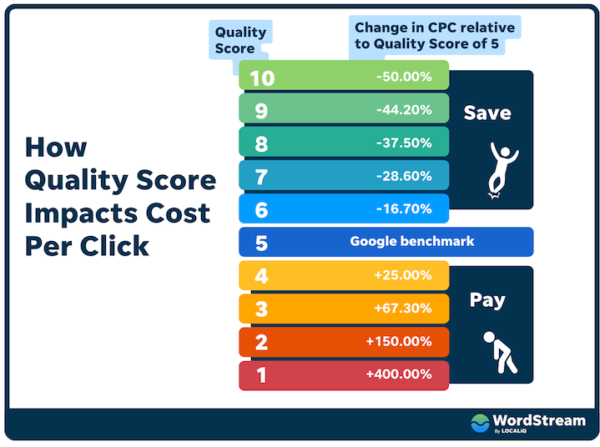
Google defines Quality Score as a diagnostic tool reflecting how well your ads, keywords and landing pages perform relative to other advertisers. It is scored from 1 to 10 at keyword level and is built from three components:
- Expected click-through rate – how likely Google thinks your ad will be clicked
- Ad relevance – how closely your ad matches the searcher’s intent
- Landing page experience – how relevant and useful your landing page is after the click.
The practical impact of this is significant. As Search Engine Land reports, a keyword-level Quality Score directly affects your Ad Rank, which in turn determines both your ad position and what you actually pay per click. A higher Quality Score means you can rank above a competitor who is bidding more than you.
Industry data consistently shows that improving Quality Score from the average of 5 out of 10 to 8 or above can reduce CPCs by 30 to 50%. On a £5,000 monthly budget, that is a meaningful saving, and it does not require increasing your spend at all.
The three fastest wins here are:
- Tighten your ad groups so that keywords, ad copy and landing page content are all aligned around the same intent. Generic ad groups with loosely related keywords are one of the most common causes of poor ad relevance scores.
- Improve landing page speed and relevance. Use Google’s PageSpeed Insights tool to identify load time issues. A slow or generic landing page will drag down your Quality Score regardless of how good the ad itself is.
- Review your ad copy against what your competitors are serving. If your expected CTR is flagged as below average, your ads are not earning clicks at the rate Google would expect for that keyword. Sharper headlines and a more specific value proposition usually move this.
Why Conversion Rate Is Your Real Safety Net
Rising CPCs hurt most when your conversion rate is not keeping pace. The maths is straightforward: if you are paying 15% more per click but converting at the same rate, your cost per lead goes up by 15%. But if your conversion rate improves by the same margin, you absorb the CPC increase entirely.
This is why landing page quality matters so much beyond its impact on Quality Score. Digital Otters’ analysis of CPC trends highlights that the advertisers absorbing rising costs most effectively are those who have separated data collection from conversion optimisation, running lower-cost campaigns to generate engagement signals, then feeding that data into conversion-focused campaigns rather than letting high-budget campaigns learn blindly.
In practice, this means:
- Audit your landing pages, not just your ads. Two advertisers in the same industry targeting the same keywords can have conversion rates that differ by a factor of three based solely on landing page quality. If your CPC is at benchmark but your cost per lead is high, the problem is downstream from the ad.
- Check your conversion tracking. If your campaigns are optimising toward incomplete or duplicate conversion events, the algorithm is learning from bad data. Clean tracking is no longer optional, it is the foundation everything else is built on.
- Set up proper goal values where possible. If Google’s Smart Bidding knows what a conversion is actually worth to your business, it can make smarter decisions about which auctions to enter and at what price.
There’s also a compounding advantage that often gets overlooked, businesses running SEO alongside their paid search efforts tend to see better Quality Scores, not due to coincidence, but because the same on-page work that goes into helping you rank organically (keyword relevant content, load times, page structure etc) directly feeds into what Google’s algorithm uses to evaluate landing page experiences.
We’ve seen this play out across our own client base. Take Borg Locks for example, they came to use with PPC already in place. And when we layered in a structured SEO strategy, organic sessions grew by nearly 200% and online sales through organic search increased by 242%. Critically, the same landing page improvements that drove those organic gains also strengthened the relevance signals their paid ads were pointing to. Another client of ours Becker UK, followed a similar path, they saw an increase fo 65% in organic traffic built on the same foundations of optimised meta data, content and technical performance that their paid activity relies on.
The pages that rank well, tend to convert well, and the pages that convert well tend to bring your CPC down.
Five Practical Steps to Take Now
- Add negative keywords regularly. This is the fastest way to stop budget bleeding into irrelevant queries. Set a recurring task to review your Search Terms report at least fortnightly.
- Use ad scheduling. Pull a conversion report broken down by hour of day and day of week. If your conversions cluster between certain hours, bid adjustments outside those windows can significantly reduce wasted spend.
- Test Microsoft Advertising. It is consistently overlooked by UK businesses, yet average CPCs on Microsoft are around 30% lower than on Google for equivalent terms. For competitive B2B keywords especially, it is worth running a parallel campaign and comparing cost per lead.
- Audit your Quality Scores. Pull your keywords report, add the Quality Score column, and segment by ad group. Look for patterns rather than individual outliers. If an ad group is sitting below 6 on average, it is costing you more per click than it should.
- Review your bidding strategy relative to your data volume. Target ROAS and Target CPA strategies require sufficient conversion data to perform well. If your campaign is not generating at least 30 to 50 conversions per month, manual CPC or Maximise Clicks may actually give you better control and lower costs.
Stop Chasing Lower CPCs. Start Chasing Better Margins.
Rising CPCs are a structural reality of the paid search market in 2026. More competition, less manual control and shrinking ad inventory are not going away. But none of that means your campaigns cannot perform.
The advertisers protecting their returns are not the ones spending the most. They are the ones feeding the algorithm better data, maintaining tighter message alignment between keyword, ad and landing page, and treating conversion rate as the primary variable to optimise – not bid price.
If your Google Ads costs are climbing and you are not sure where the inefficiency sits, a PPC audit can identify exactly where budget is being lost and what to fix first.
Jump into another related resource
Whether you’re after expert-written blogs, downloadable guides, or time-saving checklists, our Resource Hub gives you practical tools to make your marketing more effective.